
Year 6 (KS2) SATS Information
SATs are an indicator of the progress your child has made at school so far. They are not a measure of whether your child is passing or failing; they simply show what level your child is currently working to.
Pupils sit their SATs at KS2 level in Year 6. Children will take exams in English reading comprehension, grammar, punctuation, spelling, mathematical reasoning, and arithmetic.
Once the KS2 SATs are complete, they will be sent away for external marking and children should receive their results towards the end of the summer term in July of Year 6.
 |
Government Information and Guidance - National curriculum assessments: key stage 2 tests |
|
KS2 SATs Information for Parents |
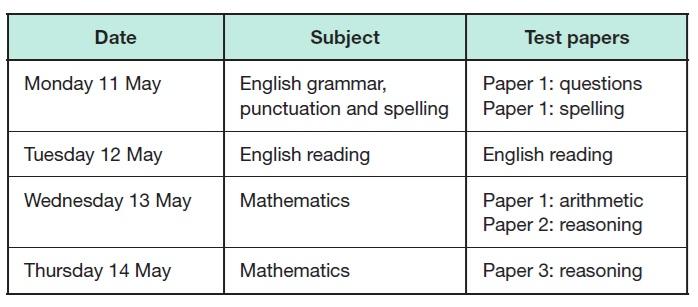
SATs 2026 Timetable
The statutory key stage 2 tests are timetabled from Monday 11th May to Thursday 14th May 2026.
What information will I receive?
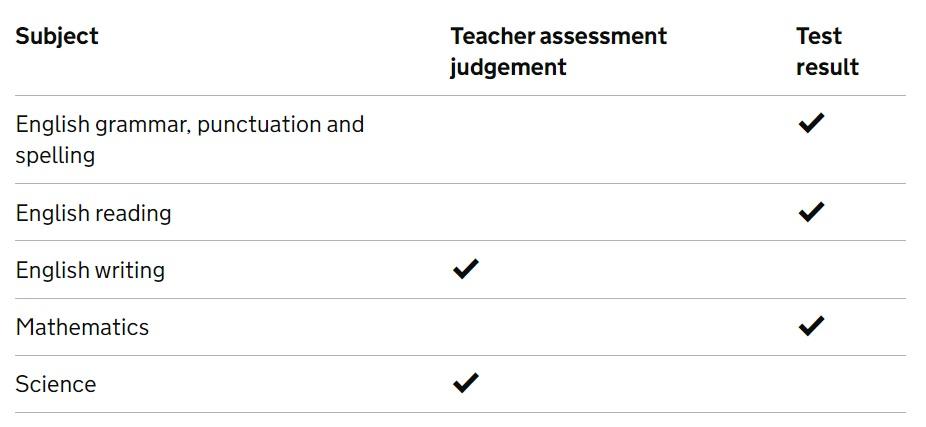
Before the end of the summer term, your child’s school will send you a report. The report will include test results and teacher assessment judgements. Together, these tests and assessments should provide you with a good sense of the standard at which your child is working in these subjects. The report your child’s teacher produces will paint a full picture of their strengths. If your child is working below the overall standard of the key stage, or they have special educational needs, reporting will be different. You should speak to your child’s teacher for more information.
Scaled Scoring
The school will report your child’s test results as a scaled score for each subject. A scaled score is created from the number of marks your child scores in a particular test. We use scaled scores to report the results of these tests to ensure we can make accurate comparisons of performance over time. At KS2 the range of scaled scores is 80 to 120. A scaled score:
- below 100 means that your child may need more support to help them reach the expected standard
- of 100 or more means that your child is working at, or above, the expected standard for the key stage
Teacher Assessment Judgements
Your child’s teacher forms their judgements by assessing your child’s work against frameworks in English writing and science. For English writing, the judgement shows if a pupil is:
- working towards the expected standard
- working at the expected standard
- working at greater depth within the expected standard
For science the judgement shows if a pupil:
- has not met the expected standard
- is working at the expected standard
Do not worry if your child is not working at the expected standard.
The results will help teachers identify where your child may need extra help. If you have any questions about your child’s results and what support they might need in secondary school, you should speak to their teacher.
How will the information be used?
The assessments are a way of making sure every child has mastered the basics when they leave primary education. The results help teachers to identify where children may need extra help or support as they move into year 7 and begin their secondary education.
Your child’s individual results, for both tests and teacher assessment judgements, will not be published by either your child’s school or the Department for Education (DfE).
However, school-level results of pupils’ attainment and progress are published on the DfE’s school performance tables website.
Key Stage Two - Reading Test
The reading test is a single paper with questions based on three passages of text. Your child will have one hour, including reading time, to complete the test.
There will be a selection of question types, including:
- Ranking/ordering, e.g. ‘Number the events below to show the order in which they happen in the story’
- Labelling, e.g. ‘Label the text to show the title of the story’
- Find and copy, e.g. ‘Find and copy one word that suggests what the weather is like in the story’
- Short constructed response, e.g. ‘What does the bear eat?’
- Open-ended response, e.g. ‘Look at the sentence that begins Once upon a time. How does the writer increase the tension throughout this paragraph? Explain fully, referring to the text in your answer.’
Key Stage Two - Spelling, Punctuation and Grammar (SPaG) Tests
The grammar, punctuation and spelling test consists of two parts: a grammar and punctuation paper requiring short answers, lasting 45 minutes, and an aural spelling test of 20 words, lasting around 15 minutes.
The grammar and punctuation test will include two sub-types of questions:
- Selected response, e.g. ‘Identify the adjectives in the sentence below’
- Constructed response, e.g. ‘Correct/complete/rewrite the sentence below,’ or, ‘The sentence below has an apostrophe missing. Explain why it needs an apostrophe.’
Key Stage Two - Maths Tests
Children sit three papers in maths:
- Paper 1: arithmetic, 30 minutes
- Papers 2 and 3: reasoning, 40 minutes per paper
Paper 1 will consist of fixed response questions, where children have to give the correct answer to calculations, including long multiplication and division. Papers 2 and 3 will involve a number of question types, including:
- Multiple choice
- True or false
- Constrained questions, e.g. giving the answer to a calculation, drawing a shape or completing a table or chart
- Less constrained questions, where children will have to explain their approach for solving a problem
SATs Support - Web-based Platforms
In addition to the work we are doing in school to prepare children for the tests, we have bought in to a number of web-based platforms which not only provide personalised questions to children based on their performance but also send feedback to staff to allow us to track progress. Although the children get some time in school to access the platforms, this is minimal and we recommend that children spend a short time each day accessing the sites alternately.
Read Theory (www.readtheory.org - personalised reading comprehensions)
Times Table Rockstars (www.ttrockstars.com/login)
SPAG.com (www.spag.com - online spelling, punctuation and grammar tests)
The log in details are on Google Classroom.
The children have personal logins for these pages. If they have lost it we can print out another slip.
Should you have any further questions regarding the tests or require passwords to access your child's account on any of the websites please don't hesitate to contact your child's class teacher.
![screenshot-2[1]](/_images/412612_l.png)
Maths SATs Revision
The following document offers a range of maths past paper questions - just download and click on the subject areas you want.
All questions contain a youtube button next to them, so if you need help, then simply hit the youtube button to zoom off to a mini tutorial, specific to that question on GHammonds channel.
Also included are the One-A-Day Mini Maths Vidamins for Year 5 & Year 6 plus links to Thinking Outside The Box puzzle videos!

Past Papers
Please access the resources by clicking on the links below.
|
SATs Papers.co.uk |
|
Government National Assessments - Past Papers |
Resources


|
Exams, anxiety and stress resources for schools and colleges | [pdf 177KB] |

|
|
|
Exam Stress Social Media Assets | [pdf 93KB] |
|